

Steam Has Too Many Games. This Tool Finally Helps You Find the Right One
 152
152
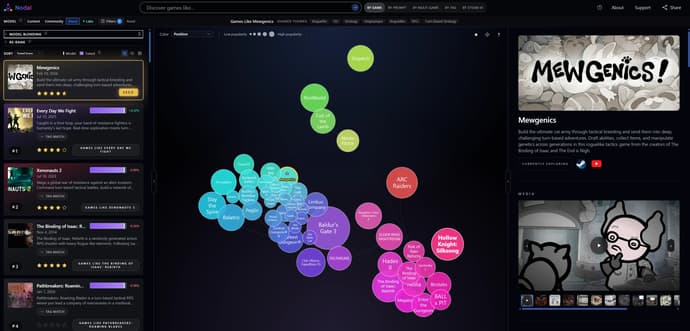
We have all been there. You close out a game you loved, you sit back, and you think: okay, what next? You open Steam. You scroll. You click around. You read a few store pages, watch a couple of trailers, and somehow still end up reopening the game you just finished because nothing else felt right.
This is not a you problem. This is a discovery problem. And for a platform with tens of thousands of games, Steam's tools for actually finding the right one have always felt strangely underpowered.
Nodal.gg is the most interesting attempt we have seen at solving that problem, and after spending time with it, we think it is worth knowing about.
The Idea Behind It
The whole site is built around one observation that sounds obvious once you hear it: similarity is not a single thing.
When you say you want a game similar to something you loved, you might mean you want the same aesthetic. The same visual tone, the same atmosphere, the same general feeling when you boot it up. Or you might mean you want something that attracts the same kind of player, even if it looks completely different on the surface. Those are two separate questions, and most recommendation tools mash them together into one blurry answer.
Nodal separates them. You can explore recommendations through a content model that focuses on shared tags, mechanics, themes, and genre, or through a community model built around player behavior and audience overlap. There is also a blended mode that combines both. In practice, flipping between these views for the same seed game produces genuinely different lists, and both are useful depending on what you are actually looking for that day.
It Looks Good Too
This part matters more than people usually admit. A lot of discovery tools are functional but ugly, which makes them feel like homework. Nodal does not have that problem.
The site has a clean, considered aesthetic that makes browsing feel like something you want to do rather than something you have to power through. The games browser is easy to move through, the layout is uncluttered, and the overall visual design gives the whole experience a polish that you do not usually expect from an indie utility site.
It sounds like a small thing. It is not. When a tool looks right, you trust it more. You spend more time with it. You are more likely to follow a recommendation down an unexpected path instead of bouncing back to something familiar.
The Visual Map Is the Star
If there is one feature that makes Nodal genuinely different from anything else out there, it is the interactive 2D map.
Rather than presenting games purely as ranked lists, the map lets you see them spatially. Titles that share strong tag-based relationships cluster near each other. Games from different corners of the Steam library spread apart. The result is something that looks a little like a constellation chart for gaming, and it is far more useful than that description makes it sound.
What the map does is shift discovery from a transactional mode into an exploratory one. A list is great when you know what you want. The map is great when you want to wander. You can zoom in on a cluster you recognize, see what sits at its edges, jump to something unexpected, and start building a mental picture of how games relate to each other in ways that storefront categories completely miss.
Some of the best finds come from noticing a game sitting just between two clusters you care about. Something that shares the mechanical DNA of one genre and the atmosphere of another. That kind of discovery does not really happen with a ranked list. It happens when you can see the relationships laid out in front of you and start following your curiosity.
Tags as a Starting Point
One of the quieter but genuinely useful parts of the site is the tag explorer. Instead of starting with a specific game, you can start with a characteristic. Something like "atmospheric" or "colony sim" or "psychological horror" and build outward from there.
This works well for those moments when you are not thinking in terms of titles you already know. You are thinking in terms of what you want to feel or do. The tag structure on Nodal is detailed enough to get specific without being so granular that it becomes overwhelming, and it connects naturally to the rest of the recommendation system.
Describe the Vibe, Get a Game
The prompt search is one of those features that sounds slightly gimmicky and then immediately earns its place.
You describe what you are in the mood for in plain language. Something relaxing but not boring. A short game with a strong story. Something that feels like autumn. Something with satisfying progression that does not demand twenty hours a week. The site processes that description and returns relevant suggestions.
The reason this works is that it matches how people actually think about what they want to play. Nobody sits down and thinks in pure genre taxonomy. People think in mood and texture and energy level. A search tool that meets you at that level is genuinely more useful than one that only responds to precise categorical inputs.
Your Library, Actually Used
Plug your Steam ID into the user section if your profile is public, and the site builds recommendations around your actual play history rather than treating you like a generic user. It also pulls together some stats about how you play and what your library says about your taste.
This is where the personalization becomes real. General discovery tools can only take you so far. Once the site knows what you have played and what you have put real time into, the recommendations get sharper and more specific in ways that feel noticeably different from the baseline experience.
The Bigger Picture
What Nodal is really doing is taking game discovery seriously as a design problem. Not "show ten related products" seriously, but actually thinking about how people form preferences, how they express intent, how they explore, and how recommendations earn trust.
The multi-model similarity system is smart. The visual map is genuinely novel. The aesthetic is polished. The prompt search is practical. The personalization layer ties everything together. These are not random features bolted onto a basic recommendation engine. They reflect a coherent point of view about what discovery should feel like.
The Steam library is enormous, and it keeps growing. The gap between "there are great games out there for you" and "you will actually find them" is a real problem that costs players countless hours of scrolling and second-guessing. Nodal is the most thoughtful tool we have found for closing that gap.
Go try it. Search for a game you love, flip between the content and community views, spend some time with the map, throw a description at the prompt search, and see what comes back. There is a decent chance you walk away with a new favorite you never would have found on your own.

Kateryna Prykhodko é uma autora criativa e colaboradora de confiança do EGamersWorld, conhecida pelo seu conteúdo cativante e atenção aos pormenores. Combina a narração de histórias com uma comunicação clara e ponderada, desempenhando um papel importante tanto no trabalho editorial da plataforma como nas interações nos bastidores.
 Roblox Construir um Zoo Códigos abril 2026Descobre todos os códigos Roblox Build a Zoo em funcionamento - troca por Gemas, Bilhetes da Sorte e Recompensas Grátis.
 Dima Ostapchuk
 Melhores escudos do Crimson Desert - Lista de classificação e como obter equipamentos de nível SUm guia completo para os melhores escudos em Crimson Desert. Compara as estatísticas de base, aprende sobre os bónus únicos e descobre onde obter equipamento defensivo de topo para a tua personagem.
 Chillplay
 Como obter o Escudo Grande de Rhonid no Deserto CarmesimProcurando o Escudo Grande de Rhonid? Segue o nosso guia do Deserto Carmesim para te esgueirares até à Mansão Lioncrest e apanhares este escudo único para uma defesa e mobilidade elevadas.Chillplay
 LCK CUP 2026 Ronda 1-2: Lista completa de equipasDescubra as classificações de poder mais recentes para as rondas 1-2 da LCK Cup 2026. Veja a posição do Gen.G, do T1 e de outras equipas coreanas na nossa tier list detalhada enquanto lutam por um lugar na MSI.Chillplay